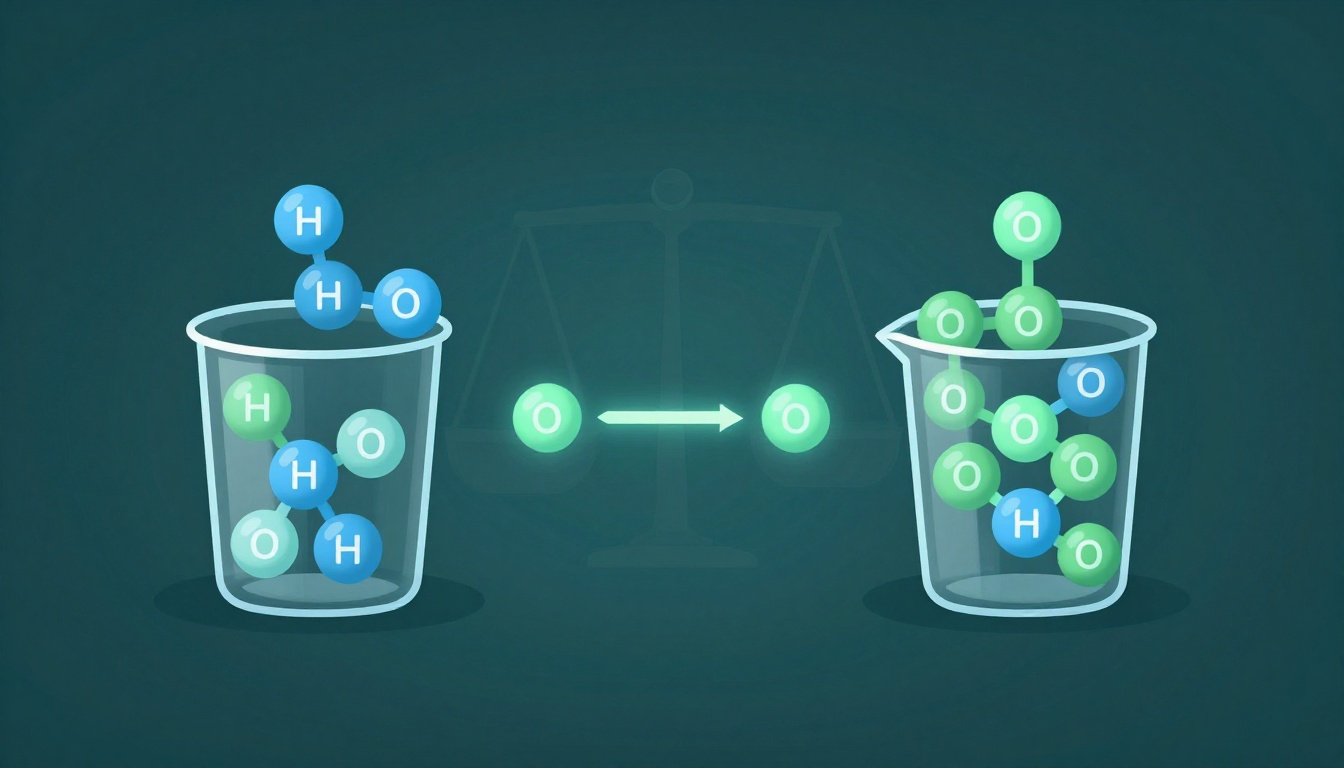
Imagine you watch a magician make atoms vanish in a puff of smoke during a chemical reaction. Atoms don’t disappear. They rearrange. That’s the magic of the law of conservation of mass.
You struggle with unbalanced equations in class or homework. Numbers don’t match on both sides. This leaves you confused. The law fixes that. It states matter can’t be created or destroyed. So, atoms on the reactant side must equal atoms on the product side.
In this post, you’ll master balancing with simple steps. You’ll see real examples and dodge common traps. First, grasp the law. Then, follow the process. Practice builds speed.
What Is the Law of Conservation of Mass and Why Does It Rule Chemical Balancing
The law of conservation of mass comes from Antoine Lavoisier in the 1700s. He weighed chemicals before and after reactions. Weights stayed the same. Reactants and products hold equal mass. Atoms stay constant too.
Think of a pizza party. You start with dough, sauce, and cheese for 10 pizzas. Guests eat them. Toppings used match toppings baked. No extra cheese appears. Matter conserves.
Chemical equations show reactions like recipes. Left side lists reactants. Right side lists products. An unbalanced equation breaks the law. For example:
Unbalanced: H₂ + O₂ → H₂O
Balanced: 2H₂ + O₂ → 2H₂O
In the unbalanced version, two hydrogen atoms and two oxygen atoms sit on the left. The right has two hydrogen and one oxygen. Atoms vanish. That’s impossible.
Balancing adds coefficients. These numbers multiply molecules. Formulas stay the same. You adjust counts without changing atoms inside. Atoms rearrange like puzzle pieces.
What if atoms don’t balance? Reactions look wrong. Calculations fail later in stoichiometry. The law rules because it enforces reality.
Key points stand out here:
- Total mass equals before and after.
- Atom counts match on both sides.
- Coefficients tweak molecule numbers only.
Lavoisier proved reactions conserve matter. Today, chemists rely on this for every equation. It keeps science honest.
This foundation sets you up for success. Now, learn the steps.
Follow These 5 Straightforward Steps to Balance Any Chemical Equation
Balancing follows a system. Trial and error works, but steps make it fast. Always respect the conservation law. Never change subscripts. Those define compounds.
Here are the five steps:
- Write the unbalanced skeleton equation. Use correct formulas. This starts everything.
- Count atoms on each side. List elements and totals. Spot imbalances.
- Balance one element at a time. Start simple. Add coefficients.
- Handle oxygen and hydrogen last. Tweak as needed.
- Verify and simplify. Check counts. Use smallest whole numbers.
Picture a flowchart. Start with equation. Branch to count atoms. Then adjust coefficients in loops. End with verification.
These steps apply to most reactions. Practice turns them automatic.
Step 1: Start with the Correct Unbalanced Equation
Formulas must match reality. Use the periodic table for charges and symbols. Hydrogen gas reacts with oxygen gas to form water. So, write H₂ + O₂ → H₂O.
Wrong formula leads to mess. Double-check ions and states later. Accuracy here saves time.
Step 2: Count Every Atom on Reactants and Products
Make a tally table. Columns show elements. Rows split left and right.
For H₂ + O₂ → H₂O:
| Element | Reactants | Products |
|---|---|---|
| H | 2 | 2 |
| O | 2 | 1 |
Oxygen mismatches. Hydrogen balances by luck.
Counts reveal problems fast.
Step 3: Adjust Coefficients One Element at a Time
Pick the easiest element. Often metals or ones in few compounds. Balance oxygen next sometimes.
For water, oxygen has two on left, one on right. Put 2 before H₂O: H₂ + O₂ → 2H₂O. Now oxygen balances at two. Hydrogen jumps to four on right. Add 2H₂ on left.
Cross-check often.
Step 4: Fine-Tune Oxygen and Hydrogen Last
These appear in water or multiple spots. Balancing early causes chains. Adjust others first. Recount. Multiply if needed.
Iteration fixes ripples.
Step 5: Double-Check and State of Matter if Needed
Sum atoms again. All match? Good. Drop fractions by multiplying. Add phases like (g) for gas.
2H₂(g) + O₂(g) → 2H₂O(l)
Lowest numbers rule.
See It in Action: Balance These Common Equation Types with Examples
Examples build skill. Pause and try each before peeking. Apply the five steps. Watch atom counts.
Example 1: A Basic Reaction Like Hydrogen and Oxygen Forming Water
Start: H₂ + O₂ → H₂O
Counts:
| Element | Reactants | Products |
|---|---|---|
| H | 2 | 2 |
| O | 2 | 1 |
Balance oxygen: H₂ + O₂ → 2H₂O (O:2=2, H:2=4). Then hydrogen: 2H₂ + O₂ → 2H₂O.
Final counts match: H4, O2 both sides.
Beginners trip here often.
Example 2: Balancing a Hydrocarbon Combustion Equation
Methane burns: CH₄ + O₂ → CO₂ + H₂O
Counts:
| Element | Reactants | Products |
|---|---|---|
| C | 1 | 1 |
| H | 4 | 2 |
| O | 2 | 3 |
Carbon balances. Balance H: CH₄ + O₂ → CO₂ + 2H₂O (H:4=4, O:2=4). Oxygen short: CH₄ + 2O₂ → CO₂ + 2H₂O.
Counts: C1, H4, O4 both sides.
Oxygen challenges combustion.
Example 3: Decomposition Reactions That Reverse Synthesis
Mercury oxide breaks: HgO → Hg + O₂
Counts:
| Element | Reactants | Products |
|---|---|---|
| Hg | 1 | 1 |
| O | 1 | 2 |
Balance O: 2HgO → Hg + O₂ (O:2=2). Then Hg: 2HgO → 2Hg + O₂.
These reverse builds.
Try neutralization next: HCl + NaOH → NaCl + H₂O. Balance easy: all 1:1.
Dodge These Frequent Balancing Blunders to Save Time and Frustration
Mistakes waste time. Spot them early.
First, don’t change subscripts. H₂O stays H₂O. Coefficients only: 2H₂O. Subscripts alter compounds.
Second, recount after tweaks. One change affects others.
Third, skip hydrogen first. It ripples.
Fourth, treat polyatomics as units. NO₃ balances together.
Fifth, simplify coefficients. Divide by 2 if even.
Sixth, add states last. They don’t affect counts.
Pro tip: Practice one equation daily. Speed comes quick. The law guides fixes every time.
Master Balancing and Take Your Chemistry Further
The law of conservation of mass demands equal atoms. Follow the five steps: write equation, count, adjust, fine-tune, verify.
Test yourself. Balance these:
- Fe + O₂ → Fe₂O₃
(Answer: 4Fe + 3O₂ → 2Fe₂O₃) - Al + HCl → AlCl₃ + H₂
(Answer: 2Al + 6HCl → 2AlCl₃ + 3H₂)
Mastery opens stoichiometry. Reactions predict yields.
Share your toughest equation in comments. Subscribe for more tips. You’ve got this, future chemist!